I have a good memory. It may even be considered a great memory by some. I remember all the things whether I want to or not. Want me to name every math professor I’ve ever had in order? I got you. If you want to add to the excitement, I could also tell you which class they taught and what my final grade was. Want me to relive some random conversation we had 5 years ago? I can also do that. Unfortunately, having a great memory also means I remember every dumb, stupid, idiotic, or embarrassing thing I’ve done. When my mental health isn’t super great, my brain tries to hyper fixate on those things in between the intrusive thoughts that bombard me.
June will mark 3 years since I started therapy. I remember when I first started, I told myself I had 7 appointments to figure my issues out and then I would be done. I was broke and knew I could only afford those 7 appointments. After about my 4th appointment, I knew it was going to take more than 7 appointments to figure all the things out and work through them. I’m not entirely sure how, but the Lord provided in such a way that I could afford my bills and continue with my therapist after that 7th appointment. In fact, by the time I left to move overseas, I had more than doubled the number of appointments I “allowed” myself to have.

It dawned on me yesterday that exactly 2 years ago, I had my last therapy appointment before moving across the globe. I would board a plane two days later, and I’m pretty sure my therapist wanted one more appointment to make sure I was actually going to get on my plane and she wouldn’t be getting a phone call from me the next week asking for an appointment. I thought that was my last therapy appointment ever. I had “finished”. I had done the work, and I was “cured”. I was “healthy”. After the appointment, I jumped in the tank of a vehicle I was driving at the time, blared some Foo Fighters and congratulated myself for “surviving” my time in therapy.
About two weeks into my move overseas, I realized the things I was working on in therapy didn’t just exist in America. They were a problem for me overseas too. Depression. Terrible sleep. Anxiety. I don’t struggle with anxiety, I’m actually great at it. I joined the kindle app family and started reading books that my therapist had recommended. Some were fun little reads that didn’t result in any gut punches, and some of them were way difficult to read and left me with a lot of questions. I found all the therapy related accounts on Instagram and Tiktok. My feeds were predominately therapy related things for the longest time. I’m still trying to break the algorithm I created for myself. When it was nearing time to return to the states last spring, it was clear to me and my close friends that I still had some stuff to hash out in therapy- probably even more than I originally realized. Even now, I feel like the list keeps growing. Are new things developing for me to work on? Not really, I’m just realizing more things and developing more questions.
If I’m honest, sometimes I’m frustrated that I’m not actually healed and am still in therapy. It’s like I’ll take one or two steps forward and then take 10 steps back. At times, I’m a broken record. I get frustrated that healing isn’t linear. I studied math in college and so my brain and thought process often falls back into thinking about life like a math problem. And how great would it be if healing was in fact like a linear function. A linear function takes the form y=mx+b. M is your slope and b is your y-intercept… so where it crosses the y axis. When I think about healing and why it should be linear, I think about the slope. The change in your y value over your change in x… the rise over the run. As I take appropriate steps to heal and resolve all of my issues, things should always trend in the positive/getting better direction, right? My favorite math professor, Mrs. Urban, described different options for slope using illustrations similar to the ones I’ve provided below. There are 4 different possibilities we have for slope, and in my mind, we should have for healing. Your slope can be positive (think you’re climbing up a mountain). It can be negative (you’re going down a mountain). It can have a slope of zero, there’s not change in the y direction (it’s a straight, horizontal line, like you are walking on a tight rope). The slope can be undefined (you are essentially free falling to your death). And for those of you wondering, this is exactly how I explain slope to any algebra student I teach.
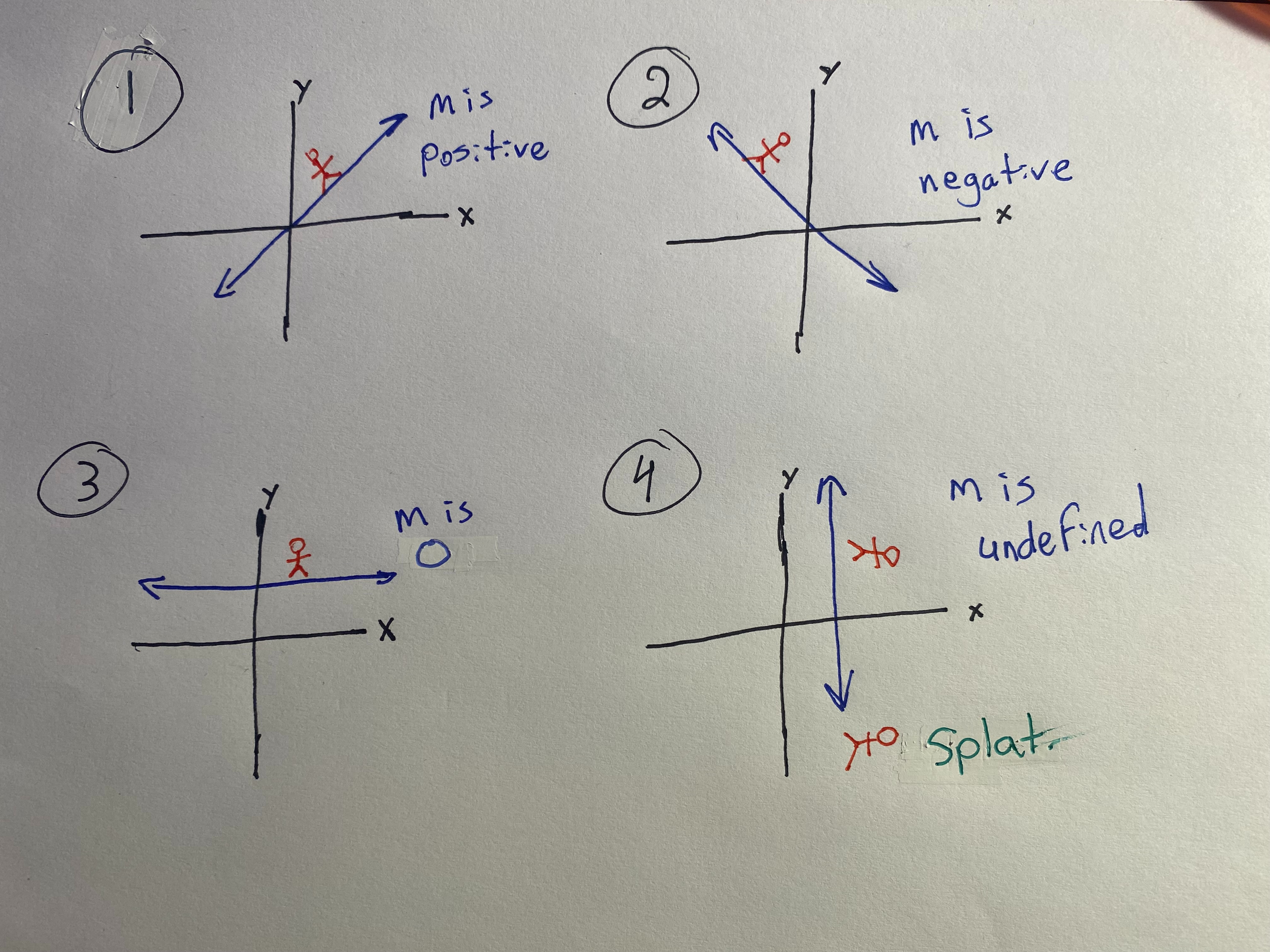
I feel like each of the graphs above have described my journey to this point. Not necessarily simultaneously, but at some point the slope has represented where I’m at. There are days I’m making some positive headway. I have that positive slope. There are some days when something happens and I’ve found myself heading in a non positive direction. Some days, I’m just chilling. Not making a change in terms of getting worse or getting better. Some days, and these are my favorite (note my use of sarcasm), the slope of my life is undefined, and I’m just freefalling without an end in sight.
I’ve been racking my brain trying to figure out some kind of graph or mathematical model that accurately represents what the healing journey looks like. I’m a visual learner. I have to see things, usually more than once, to truly understand it. If I had some kind of relatable image of what healing should look like, maybe I would be less frustrated with the journey I’m on. Is it like a sine or cosine graph? They both involve going up and down at different intervals, but both are predictable. You know exactly how both of those functions are going to look. I also wondered if it was like a higher level polynomial graph? Like the previously mentioned trig functions, it’ll change throughout the course of time. There will be periods of increase and decrease, but depending on the degree of the polynomial, the highest exponent of x, we also know to some extent what will happen and what will be the final product of the graph. Healing isn’t predictable though so that rules out both options. For the sanity of all of you non math people, I’ve opted not to include images of the above functions. But, if you want to know, I’d be happy to share.
Maybe a piece-wise function is the best attempt to graphically illustrate healing, but even then… is it really? The moral of the story and this rambling post about math and healing is, healing takes time. I don’t know that there is an accurate graph or model to describe what it “should” look like. Everyone has a different life story and different things to work through. Everyone works through things at a different pace. Everyone processes and understands things differently. So everyone’s healing journey and process is going to look different.
There is an image that makes its way across the internet towards the end of every year and sometimes randomly throughout the year. It says something along the lines of I’m not comparing myself to anyone else. I’m comparing myself to me from this time last year because that’s all that matters. Am I doing better? The answer for this question for me, is I think so. I think I’m doing better, and that’s the important thing.
I’m sure I’ll still find myself frustrated at times as I continue on this adventure of therapy and journey to healing. But I hope those times of frustration will be less frequent. I hope that I would stop looking for some perfect image of what healing should look like. I hope that I stop comparing my journey to the journey of others and just embrace where I am and what I need to do. I hope that I will choose to be grateful for the growth that has happened and the small glimpses of healing that the Lord has allowed me to see.
Healing isn’t linear, and while I don’t like it, that’s okay. I’ll just start telling myself that similarly to how math gets more fun when you deal with nonlinear functions, life is also more fun because of things that are nonlinear.
 Grief. Going. Healing.
Leave a comment